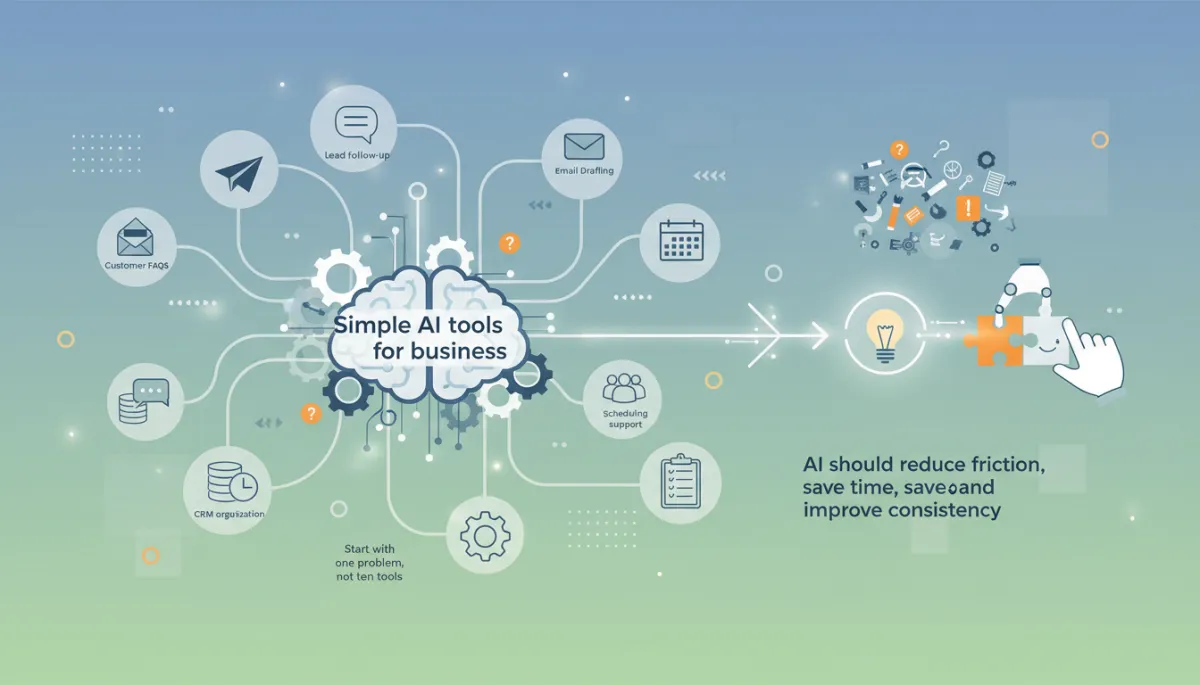
Simplify AI for Small Business Success
Small Business, AI, Systems, Automation
How Small Businesses Can Start Using AI Without Overcomplicating It
AI is everywhere right now, but that doesn’t mean your business needs a complicated setup to benefit from it. In fact, the most effective AI for small business usually starts with simple, practical changes that save time and remove friction from your day-to-day work.
AI Doesn’t Need to Be Complicated to Be Valuable
When people hear “AI for small business,” they often picture huge enterprise systems, technical teams, and big budgets. That’s not what most service-based businesses or growing teams actually need. You don’t have to reinvent your entire operation or become a tech expert. You only need to use AI where it solves real, everyday problems: slow follow-up, repetitive admin, scattered information, or content that never gets finished.
At Still In Frame Creatives, we see the same pattern over and over: the businesses that win with AI are the ones that start small and stay practical. They use simple AI tools for business tasks that already exist, instead of chasing every new platform that launches.
Why Small Businesses Get Stuck With AI
If you’ve felt overwhelmed trying to figure out how small businesses can use AI, you’re not alone. There are a few common reasons owners and teams get stuck:
Too many tools: Every week, there’s a new “must-have” AI app. It’s tempting to sign up for several and then never really use any of them properly.
Too much noise online: Social media is full of big promises and hype. It’s hard to know what’s actually relevant to a local service business, boutique agency, or growing team of five to twenty people.
Pressure to move fast without a plan: There’s a sense that if you’re not using AI automation for small business right now, you’re behind. That pressure can push people into rushed decisions instead of thoughtful ones.
Fear of getting left behind: Fear can be a strong motivator, but it’s not a good strategy. Adopting AI just because it sounds exciting—or scary—rarely leads to real results.
The result? A lot of logins, a lot of half-built automations, and not much actual change in how the business runs day to day.
A Better Way to Start With AI: One Problem, Not Ten Tools
Instead of asking, “How do we use AI everywhere?”, a more useful question is: “Where are we losing time, missing opportunities, or repeating work?” That’s where practical AI for business makes a difference.
Start by identifying repetitive tasks. Think about what your team does over and over: sending similar emails, answering the same questions, manually updating records, rewriting the same content for different platforms.
Look for missed opportunities in the customer journey. Do leads sit in your inbox for days? Do people fall through the cracks after a discovery call? Are you slow to follow up after someone fills out a form?
Focus on one area where speed, consistency, or time savings really matter. That might be lead follow-up, onboarding, or staying in touch with existing clients.
Keep implementation simple. One clear workflow, one or two simple AI tools for business, and a way to measure whether it’s actually helping.
💡 Key idea: A clear strategy matters more than having the most tools. Decide what problem you’re solving first; pick tools second.
Practical Ways Small Businesses Can Start Using AI Today
Here are straightforward, low-friction ways to start getting value from AI automation for small business—without rebuilding your entire tech stack. These work especially well for service-based businesses and growing teams.
Drafting follow-up emails: Use AI to turn quick bullet points into clear, professional follow-up emails after discovery calls, proposals, or project updates. You still review and personalize; AI just handles the blank page.
Responding faster to leads: Connect AI to your form submissions or inbox so new inquiries receive a friendly, on-brand response quickly—confirming you’ve received their message and offering next steps or a booking link.
Organizing contact or CRM data: AI can clean up messy contact lists, standardize fields, tag leads by service type, or summarize key details from notes into your CRM. This makes it easier to see who needs attention and when.
Creating content outlines or repurposing content: Instead of writing from scratch, use AI to outline blog posts, email sequences, or social content. You can also feed it a podcast episode, webinar, or blog and have it generate shorter pieces for other platforms—so one asset works harder for you.
Answering common customer questions: Build a simple AI-powered FAQ assistant based on your existing website copy, pricing information, and policies. It can handle the routine questions and free your team to focus on more nuanced conversations.
Summarizing notes or meetings: After client calls, use AI to turn transcripts or rough notes into clear summaries, action lists, and next steps. This improves consistency and keeps projects moving without relying on memory.
Supporting appointment scheduling or intake: Pair AI with your scheduling tool or intake forms so new clients get tailored confirmation messages, reminders, and prep instructions that match your brand voice.

Simple AI workflows work best when they support clear, existing processes.
In all of these examples, AI is not replacing your team or your strategy. It’s helping you do what you already do—only faster, more consistently, and with less manual effort.
What to Avoid When Getting Started With AI in Business
Buying too many tools too fast: More platforms do not equal more impact. Start with one or two that directly support a specific workflow, then expand if needed.
Automating messy processes before fixing them: If your intake, handoff, or follow-up process is unclear, AI will only speed up the confusion. Clean the process first; then add automation.
Removing the human touch where it matters most: The best AI setup supports your team instead of replacing human connection. Keep humans in key moments: sales conversations, sensitive client updates, and strategy decisions.
Expecting AI to replace business strategy: AI can help you execute, but it can’t decide who you serve, what you offer, or how you position your brand. Those strategic decisions still need your leadership.
📌 Key takeaway: AI should reduce friction, save time, and improve consistency—not create more complexity or distance you from your clients.
What a Smart AI Starting Point Looks Like
A strong first step with AI for small business is usually simple and specific. It might look like this:
One clear use case: For example, “We want to respond to new leads within 10 minutes during business hours,” or “We want every client call summarized with action items within 24 hours.”
One simple workflow: A straightforward, step-by-step process that might connect your website form, email, CRM, and an AI assistant—without a maze of extra tools.
A measurable business benefit: Faster response times, more booked calls, fewer no-shows, lower admin hours, or more consistent client communication. If you can’t measure it, it’s hard to know if it’s working.
Team adoption that feels manageable: Everyone who touches the workflow understands what AI is doing and where they step in. No one feels like the system is “taking over” or creating extra work.
When AI is introduced this way, it supports your team instead of overwhelming them. It becomes a quiet, reliable part of how you operate, not a shiny object you’re constantly trying to figure out.
Start Small, Stay Strategic, and Let AI Work for You
You don’t need to do everything at once to benefit from AI. In fact, you shouldn’t. The most sustainable approach to getting started with AI in business is to:
Pick one real problem in your current operations.
Choose a simple AI-supported workflow to address it.
Measure the impact, then decide what to improve or add next.
Over time, these small, intentional changes stack up. You get faster, more consistent, and easier to work with—without losing the human connection that makes your business unique.
Need Help Finding the Right Starting Point?
If you’re trying to figure out where AI actually fits in your business, Managed Marketing Partners can help you build a practical strategy that makes sense for how you work. We focus on clear systems, thoughtful automation, and AI that supports your team instead of replacing it—so growth feels more manageable, not more chaotic.
Whether you want to streamline lead follow-up, organize your CRM, or repurpose content more efficiently, we can help you design simple AI workflows that actually move the needle. When you’re ready to explore practical AI for business, reach out and let’s map out a starting point that fits your goals, your team, and the way you serve your clients.